
Your direct route to rolex replicas for sale cheap in the USA
Table of contents
A Buyer’s Field Guide to the Rolex Super Clone 2236 Movement
I have owned five Datejust-style clones in four years and sent two of them back. The ones that stayed on my wrist were never the most expensive, and none of them had the prettiest macro photos. What separated them was something almost no review discusses: whether the movement inside matched the way I actually wear a watch. That is the angle here, and it is why most of this guide revolves around the 2236 caliber. For a Datejust-shaped rolex super clone, it is the most sensible engine in the current market, and understanding why will keep you from overpaying for specifications you will never notice on your own wrist.
The 2236 Movement Without the Marketing Noise
Rolex introduced Caliber 2236 in 2014 inside the Datejust 31, replacing the 2235. It runs at 28,800 vibrations per hour, uses a Syloxi silicon hairspring, and Rolex rates it at 55 hours of power reserve. Now here is where replica listings start bending the truth. In the clone market, 2236 is a label applied to a family of movements rather than one exact object. Most of what you buy is not a ground-up reverse engineering of the original. It is a decorated platform, typically a Hangzhou or Seagull base derived from the ETA 2824 architecture, with bridges, rotor engraving, jewel positions and perlage reworked to mirror the 2236 layout. Factories put their effort into the balance bridge silhouette and the date mechanism, because those are the parts a curious buyer sees first when the caseback comes off.
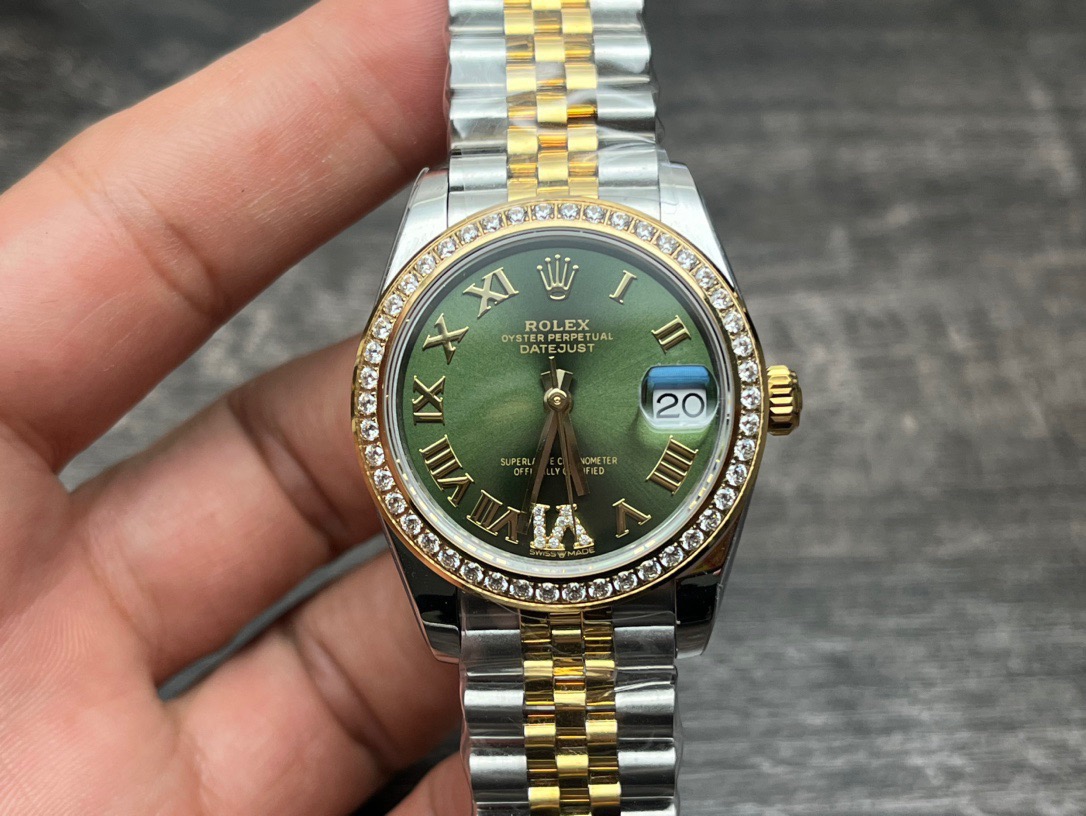
From the outside, the resemblance is genuinely convincing. The rotor shape, the engraving font and the balance cock profile are close enough that a jeweler glancing at it would not flinch. Internally, the gear train is not a true copy, and anyone who tells you otherwise is either misinformed or selling. The practical consequence is that service follows 2824 logic rather than Rolex logic. A local watchmaker can regulate it, swap a balance complete, or replace a winding pinion without hunting for genuine 2236 parts that do not exist at retail. That single fact matters more than any spec sheet, because the first thing to fail on a clone movement is almost never the gear train. It is the winding system, the keyless works, or a rotor bearing that gets noisy after eighteen months of daily wear. For a 2236-based rolex super clone, knowing the base caliber is the difference between a watch you maintain and a watch you throw away.
What “1:1 Clone” Should Actually Mean to You
In replica watch circles, “1:1 clone” is used like a quality grade. It is not one. On a rolex super clone from a decent factory, 1:1 usually refers to external case dimensions and dial geometry, not movement architecture. A factory can build a case that measures exactly like a Datejust 36 and still run a modified 2824 inside. Both statements can be true at the same time, and that is fine. What you should verify instead is whether the movement accepts standard 2824 parts, whether the date wheel centers cleanly in the window, and whether the crown threads engage smoothly from the very first turn. Those three details decide daily usability far more than a listing page slogan. In my experience, sellers who lead with 1:1 and never name the base caliber are usually hiding something about what is actually bolted inside the case.
Power Reserve and Service Reality
The 55-hour figure on the original does not transfer to the clone. From what I have measured across four 2236-based pieces, real autonomy lands between 38 and 44 hours when fully wound, and closer to 36 once the movement has a year on it. That is still enough for a desk-to-dinner rotation, but it means a Friday-night wind will not carry you to Monday morning. Amplitude on a fresh clone typically reads 270 to 290 degrees on a timegrapher, which is healthy, though it drops noticeably if the watch sits unworn for weeks at a time. Service cost is the quiet advantage here: a full clean and re-oil runs $80 to $140 at an independent watchmaker, versus $300 and up for a 3135-based build where parts are scarcer and labor is more specialized. Across the replica watches market, that service gap is the single most underrated reason to prefer a 2236 build for a Datejust.
2236 vs 2824 vs 3135: The Comparison Nobody Makes
Most comparisons online put movements side by side on paper, which tells you almost nothing about ownership. The three engines you will actually encounter in Datejust and Submariner clones behave very differently in real life. The plain 2824 family is the workhorse: cheap, universally serviceable, mechanically honest, but its bridges and rotor look nothing like a Rolex movement once the caseback is open. The 3135 clone is the Submariner standard, delivers an instant-jump date, and feels more refined when winding, but it costs more to buy and considerably more to fix. The 2236 sits in a useful middle ground. It gives you the visual layout of a modern Datejust movement, keeps 2824-based service economics, and runs quietly enough that you forget it is there.
The rolex super clone market splits roughly along those three lines, and the mistake buyers make is choosing a movement based on reputation rather than on which case it was designed for. A 3135 inside a Datejust case is not automatically better than a 2236. It is simply a different set of tradeoffs, and in most cases the factory has spent more time refining the case that matches the movement they build most often.
Stability, Noise and Thickness in Daily Wear
Noise is the underrated variable. A stock 2824 has an audible rotor whir when you move your wrist quickly, and some buyers find it distracting in a quiet office. The 2236 clone I currently wear is quieter than a bare 2824 but not as silent as a well-tuned 3135, which is a reasonable trade at this price. Thickness is the other honest difference. Genuine 2236 measures around 4.0 mm; clone versions typically add half a millimeter to a full millimeter because of the decorated plate stack. In a 36 mm case that extra height changes how the watch sits under a shirt cuff, and it is the one area where I would rather have a thinner case than a prettier movement finish. If you wear slim shirts or a suit daily, weigh that before you fall in love with a movement photo.
Two Buyer Mistakes That Cost Real Money
The first mistake is treating quoted specifications as measured reality. Listings routinely advertise a 55-hour reserve and Swiss-grade finishing on movements assembled from Chinese components. I have tested this directly: wind the watch fully, set it down dial-up, and check it every six hours. Anything that dies before 36 hours is either under-lubricated or has a weak mainspring, and that tells you more about the seller than any product page ever will. The second mistake is assuming the most expensive listing is the closest to genuine. In this market, price buys finishing, bracelet quality and after-sales response, not accuracy. A $550 piece and a $380 piece often run the same movement. The difference shows up in case bevels, end link fitment and how the clasp snaps shut, and those are visible only if you ask for close-up photos or video.
A third pattern I see constantly is buyers judging a best rolex replica by its dial print under a loupe before they have ever checked the bracelet. End links that sit proud of the lugs, a clasp that rattles, or a crown that feels gritty are the things you notice every single day. Perfectly printed text at 4x magnification is something you look at twice a year. One common mistake is ordering the reference with the most breathless review on a forum, when the honest question is which reference the factory has been building longest. Tooling wears, dial suppliers change, and a model that was excellent eighteen months ago may be coasting on reputation now. Ask the seller how long they have carried that specific reference and whether the current batch uses the same movement as the last one. Vague answers are your answer.
Wrist Test vs Macro Test
Here is the distinction I wish someone had explained to me before my first purchase. Almost every review you read is a macro test: a 10x magnified photo of the rehaut engraving, the dial coronet, the date font. Those images are useful, but they describe a viewing condition that does not exist in normal life. Nobody stands a foot from your wrist with a loupe. The wrist test is what actually happens. A person sees your watch from 60 to 100 centimeters away, in motion, under indoor light, for two or three seconds. At that distance, what registers is case proportion, bracelet taper, dial color accuracy and how the watch sits on your arm.
Once you accept that, the buying logic changes. If your goal is to pass the wrist test, a mid-tier rolex super clone with a well-proportioned 2236 build will do everything you need, and spending another $200 on macro-level dial detail is money burned on something nobody sees. If you genuinely enjoy the macro side, meaning you photograph your watches and compare them side by side with reference images, then pay for it, because it is a real hobby and the details matter to you. What you should not do is pay macro prices while holding wrist-level expectations. I have watched buyers return perfectly good watches because a date wheel font was marginally off, then replace them with pieces that had worse bracelets and worse timekeeping. Decide which test you are actually taking before you open your wallet, and let that decide your budget ceiling.
There is a useful second layer to this. The wrist test rewards proportion and the macro test rewards detail, and the two are rarely optimized together at the same price. A factory that spends its margin on a beautifully engraved balance bridge is often the same factory that fits a slightly loose bracelet. Knowing which one you care about is worth more than any recommendation list, because the person writing that list has a different wrist, a different job and a different tolerance for imperfection than you do.
How the Main Factories Compare Right Now
Among current producers, Clean Factory is the name most often attached to Datejust builds, and for good reason. Their case finishing and bracelet articulation are consistently strong, the end links seat tightly against the lugs, and their 2236-based models hold up well over a year of regular wear. VSF dominates the Submariner conversation with their 3235 work, but their Datejust output is less consistent in my experience, particularly around dial color matching under different light. GM offers a value option that gets you most of the visual result for noticeably less money, though the bracelet feels lighter and the clasp action is a step below Clean. BT is worth mentioning mainly for chronograph work, not for this segment.
If you are comparing super clone watches across these factories, focus on the specific reference rather than the brand name. A factory that nails a 41 mm Datejust may be mediocre on a 31 mm, because the tooling and dial suppliers differ between lines. Ask the seller which factory and which reference, and be suspicious of anyone who answers vaguely or claims they cannot disclose it. Also ask about the movement batch, since factories quietly switch base calibers between runs. A 2236 build from a good batch is stable; the same model from a rushed batch can arrive with a misaligned date wheel or a rotor that touches the caseback. From what I have seen, batch consistency matters more than factory reputation for any single purchase, and the sellers who admit that are the ones worth buying from.
What a Fair Price Looks Like, and Where to Buy
Current street pricing for a 2236-based Datejust clone runs roughly $360 to $560 depending on factory, bracelet type and dial finish. Jubilee bracelets typically add $30 to $50 over oyster, and two-tone models add more because of the gold plating process. Anything under $300 is usually a lower-tier build with a 2813 or an undecorated 2824, and anything over $650 is either a rare reference or a seller working with a very generous margin. I would rather buy a $420 watch from a seller who answers questions clearly than a $380 watch from a listing with stock photos and no movement details. The cheap end of this hobby is rarely cheap once you count the replacement.
For sourcing, I have had the most consistent results with replicafactory.cx, which stocks 2236-based Datejust builds and answers movement questions directly instead of deflecting them. Their listings name the base caliber, which is the single best signal of an honest seller. If you want to browse a wider catalog of Rolex replicas before committing to a reference, Rolex replicas is a reasonable place to compare dial options and case sizes side by side. Wherever you buy, pay with a method that offers recourse, and confirm the return window in writing before the parcel ships, because the first 48 hours after delivery are when most problems surface.
Sizing, Waterproofing and Living With It
Two practical notes that most reviews skip entirely. First, sizing. Clone bracelets often ship with all links installed and use friction pins that are tighter than genuine. Take it to a watchmaker rather than doing it yourself with a paperclip, because scratching a fresh brushed finish on day one is a common and completely avoidable regret. Second, water resistance. Even when a listing claims 100 meters, the gaskets on clone cases are not tested to that standard. I treat every replica as splash-resistant only, meaning hand washing is fine and swimming is not. Have it resealed with silicone grease at the first service if you plan to wear it in rain regularly, and never trust a screw-down crown you have not personally felt seat.
One more thing worth saying plainly. Wherever you search, whether you type where to buy fake rolex into a search bar or browse swiss replica rolexes listings that use the word Swiss very loosely, the same rule applies. The seller’s willingness to discuss the movement is the best predictor of what arrives in the box. Sellers who only talk about how the dial looks under a loupe are usually compensating for something mechanical. If you see the phrase rolex imatation used in a listing title with no caliber information attached, treat that as a warning rather than a keyword. And when you find rolex replicas for sale cheap at $150 with Swiss movement claims, understand what you are buying: a disposable watch, not a serviceable one. Buying replica watches from a seller who names the base caliber, quotes real service costs and answers follow-up questions is worth an extra $40 every time.
FAQ
Is the 2236 clone a true 1:1 copy of the Rolex movement?
No. It is a decorated platform based on the 2824 family, with bridges and rotor shaped to resemble the 2236. Externally it looks close; internally the gear train differs. What you get is 2824 serviceability with a Rolex-style appearance.
How accurate is the 2236 clone out of the box?
Most arrive running within plus or minus 12 to 20 seconds per day. A $30 regulation by a local watchmaker usually brings that to within 8 seconds. Do not expect chronometer accuracy at this price point.
Can a local watchmaker service a 2236 clone?
Yes, as long as they are willing to work on replicas. Most independents will, since the internals are 2824-compatible. Expect $80 to $140 for a clean, oil and regulate.
Why does my watch stop overnight when the listing says 55 hours?
Because the clone does not deliver 55 hours. Real-world reserve is 36 to 44 hours when new. If yours dies under 30 hours, the mainspring or the lubrication is suspect and you should raise it with the seller immediately.
Is a 3135 clone better than a 2236 clone?
Not universally. The 3135 suits Submariner builds and offers an instant-jump date, but it costs more to buy and much more to repair. For Datejust references, the 2236 is the more practical choice.
How can I judge bracelet quality before buying?
Ask for a video of the clasp opening and closing, plus a photo of the end links seated against the case. Tight fitment and a firm clasp snap are the two clearest indicators, and both are visible on video.
Do these watches hold value?
No. Treat the purchase as a wearing expense, not an asset. Resale typically returns 50 to 65 percent of what you paid, and only if the bracelet is unpolished and the case is clean.

